Polystyrene Sheet Pressing from Pellets (13 mm)
2 min lire
By Plastic Hub February 4, 2026Temperature and pressure profiles for pressing GPPS polystyrene sheets using a programmable heated press
Table des matières
Overview
This article documents a validated process for pressing 13 mm thick GPPS polystyrene sheets from pellets using a heated sheet press with fully programmable temperature and pressure profiles.
The goal is a low-stress, bubble-free, warp-free plate, suitable as a baseline recipe for further optimization.
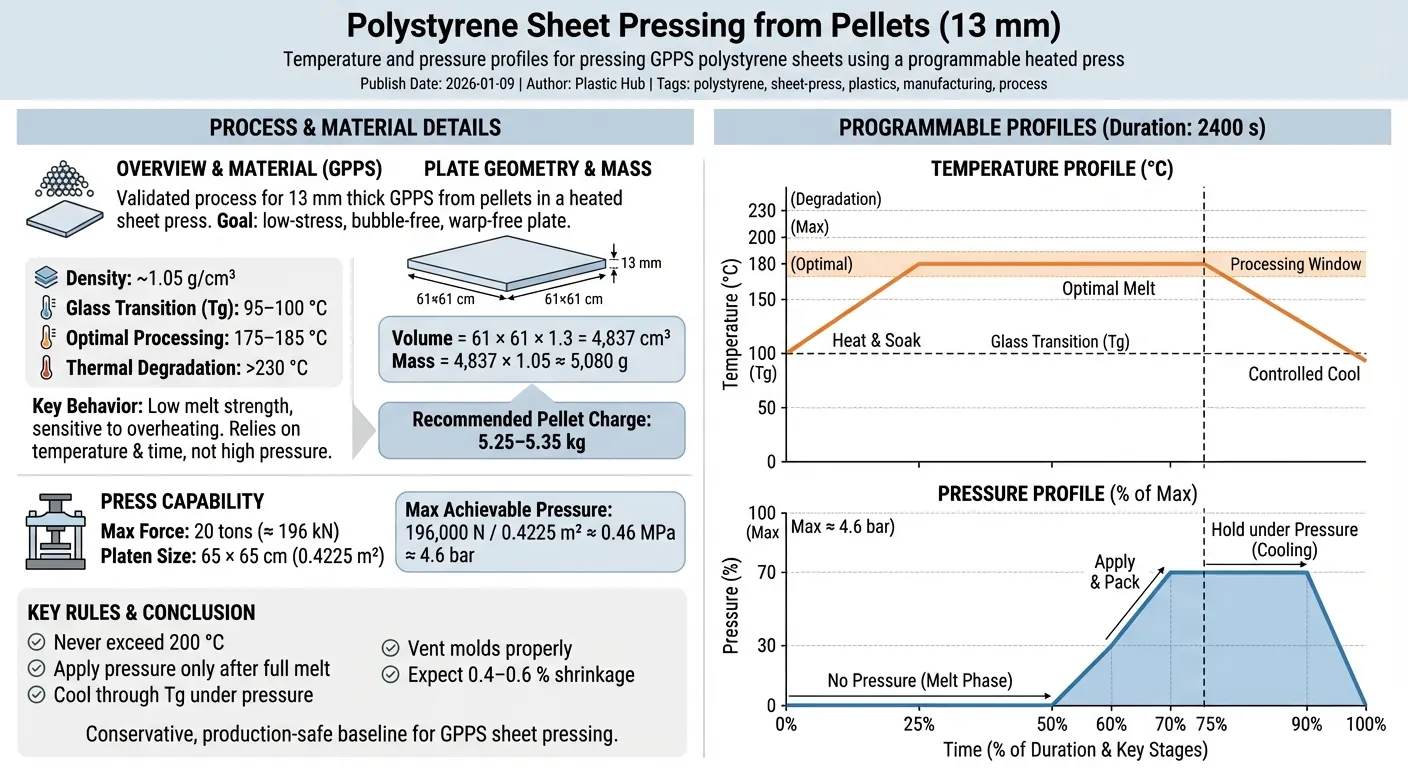
Material Properties (GPPS)
- Density: ~1.05 g/cm³
- Glass transition (Tg): 95–100 °C
- Optimal processing window: 175–185 °C
- Thermal degradation: >230 °C
- Key behavior: low melt strength, sensitive to overheating
Polystyrene relies primarily on temperature and time, not high pressure, for good inter-pellet fusion.
Plate Geometry & Mass
- Final size: 61 × 61 cm
- Thickness: 13 mm (1.3 cm)
Mass calculation
Volume = 61 × 61 × 1.3 = 4,837 cm³
Mass   = 4,837 × 1.05 ≈ 5,080 g
Recommended pellet charge: 5.25–5.35 kg
Press Capability
- Maximum force: 20 tons ≈ 196 kN
- Platen size: 65 × 65 cm (0.4225 m²)
Maximum achievable pressure
196,000 N / 0.4225 m² ≈ 0.46 MPa ≈ 4.6 barController Scaling Model
x = 0–1000→ 0–100 % of total durationmax = 200→ 200 °C = 100 %
Examples:
y = 900→ 180 °Cy = 450→ 90 °C
Temperature Profile (Safe / First Run)
{
  "duration": 2400000,
  "max": 200,
  "controlPoints": [
    { "x": 0, "y": 500 },
    { "x": 250, "y": 900 },
    { "x": 600, "y": 900 },
    { "x": 750, "y": 900 },
    { "x": 1000, "y": 450 }
  ]
}
Pressure Profile
{
  "max": 100,
  "controlPoints": [
    { "x": 0, "y": 0 },
    { "x": 500, "y": 0 },
    { "x": 600, "y": 30 },
    { "x": 700, "y": 70 },
    { "x": 900, "y": 70 },
    { "x": 1000, "y": 0 }
  ]
}
Key Rules
- Never exceed 200 °C
- Apply pressure only after full melt
- Cool through Tg under pressure
- Vent molds properly
- Expect 0.4–0.6 % shrinkage
Conclusion
This document provides a conservative, production-safe baseline for pressing GPPS polystyrene sheets from pellets using a programmable press.